
As you reach a ripe old age in my country each new health professional who meets you has a file of your medical history. Mine is a hefty document. Most medics thumb through it quickly.
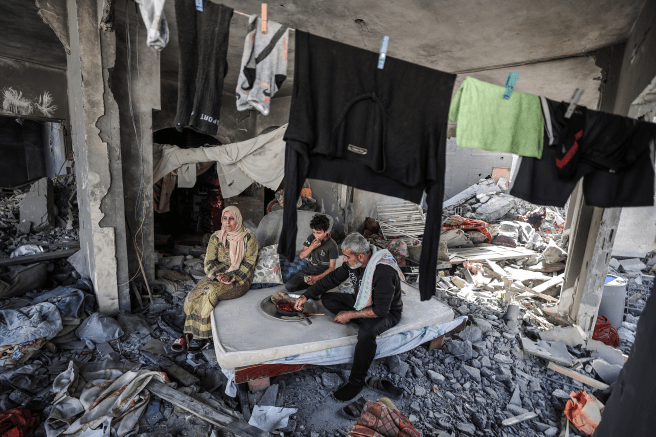
This medic, not my regular GP, is not thumbing. She is pondering. ‘You lived close to war when working in the displaced persons’ camp on the Thai Cambodia border and later in the west of Cambodia within the sounds of shells falling. Can I ask you a personal question?’ I nod. I imagine she may be troubled by the images, night after night, of the devastation of Gaza. She looks down at the file, not at me. ‘What did that do to your faith?’
I make a guess that she is uncomfortable about asking and doesn’t need a long answer. ‘Changed my faith in a way that makes it stronger.’ I say.
After that that I add a few words about those imprisoned in a barbed wire enclosure, heavily guarded and directly in the line of fire. In dark times I have seen people trapped there offering extraordinary care for each other. I tell of the wives and mothers of the dead holding each other and mourning … while I, the foreigner, was driven to safety.
I duck out of answering the question I was asked.
That night, while trying to sleep, I wonder what I could, or maybe should have said.
I saw children, young boys, hauled up on to tanks and immediately conscripted into the army. I saw them on return from battles changed by what they had seen and what they had done. I was close to a little bamboo and thatch shelter, a place where a young soldier returned from battle so desolate that he wrapped his arms around his wife, detonated a hand grenade behind her back and blew them both to pieces.
All I could say then was, ‘God! Where are you?’
I stood at a rough bamboo bench where the body of a young Vietnamese man (the enemy to the faction controlling this camp) had been dumped close to death after horrible torture. He could no longer see but he grabbed my hand and poured out words I could not understand. All that I could do was to pray that he would die quickly and that those who loved him would never know of the agony of his death. He was calling out for his mother.
All I could say then was, ‘God! Where are you?’
.
“Let me keep my distance, always,
from those
who think they have the answers.
Let me keep company always
with those who say
‘Look!’ and laugh in astonishment,
and bow their heads.”
Mary Oliver, from ‘Mysteries, Yes’ in Evidence: Poems
Look.
Let me try to answer that question. What did it do to my faith?
I grew up in a family staunchly Irish Catholic. We were strongly on the side of peace rather than war. I remember the Second World War and the bombing of two Japanese cities. We had prayed for peace, but not this way.
Later I joined the YCW and learned a new way of praying: to spend a silent time at the start of each day meditating on Jesus in the gospel.
I understood God as loving the world so much that God ‘became flesh’, being born as a child, growing in age grace and wisdom, teaching and healing joyously among those who would listen, … blessed are they who hunger and thirst after justice … blessed are the peace makers for they shall see God …
In my own journey, stumbling to find meaning in life, I eventually put aside an hour each day, preferably at daybreak, to silently meditate in the presence of God. And that gave me peace.
In my days among Cambodians who were suffering so much (and in other days of suffering that are not part of this reflection) I held firm to that daybreak time of silent openness to God. I drew strength from friends around me day by day, many Buddhist, some Christian, some who professed no faith, while all possessing grace and wisdom. I saw valiant Cambodians giving their lives to silence the guns in their country.
Jesus talked of ‘the reign of God’ as something to construct; love one for another, justice for all, a flourishing humanity, all creatures, and the earth itself, evolving as the Creator God intended it to be.

Jesus lived in dangerous times. His country was colonised and held captive under the brutal rule of the Roman Empire. He did not shrink from pointing to wrongdoing and injustice, though he knew the consequences. Some hoped that he would lead the nation to freedom from Roman occupation; his cousin John who also had many followers was imprisoned and beheaded. Jesus was destined to die an even more terrible death. He lived life to the full, suffering included.
He promised that when he was gone the Spirit of God, the Creator Spirit, would guide us throughout the ages. His Spirit would live on in us.
Across the world there are converging manifestations of faith: differing stories, rituals and histories strengthen the Spirit of each of us.
I have faith that this creation can become all that the Creator intended. While I weep at the terrible drama of war played out across the world, I hold the goodness I have seen.
Silence the guns.

 Stories and Musings