

Long ago, while close to war and atrocity, I learned that every act of goodness, every sign of beauty, must be noticed, remembered and treasured.
It is happening again.

Consider the orange tree that I have inherited. Until the time that Spring emerges in its fullness, I forget the joy of the perfume of orange blossom. No wonder jazz-age brides tucked a little sprig of it into the corner of their veils. As a child I supposed that my mother did that too, but she was a Boxing Day bride. I wish I had asked her. Was this perfumed blossom so favored that it could be imported out of season?
If I open the front window, if I walk up or down the stairs to the front gate, it is there. This orange blossom, the sight of it and the perfume of it. A four-step staircase leads up to the entrance to Unit 5 and to my tiny garden. The orange tree, fruiting or flowering, is the first plant you would notice if you climbed those steps.
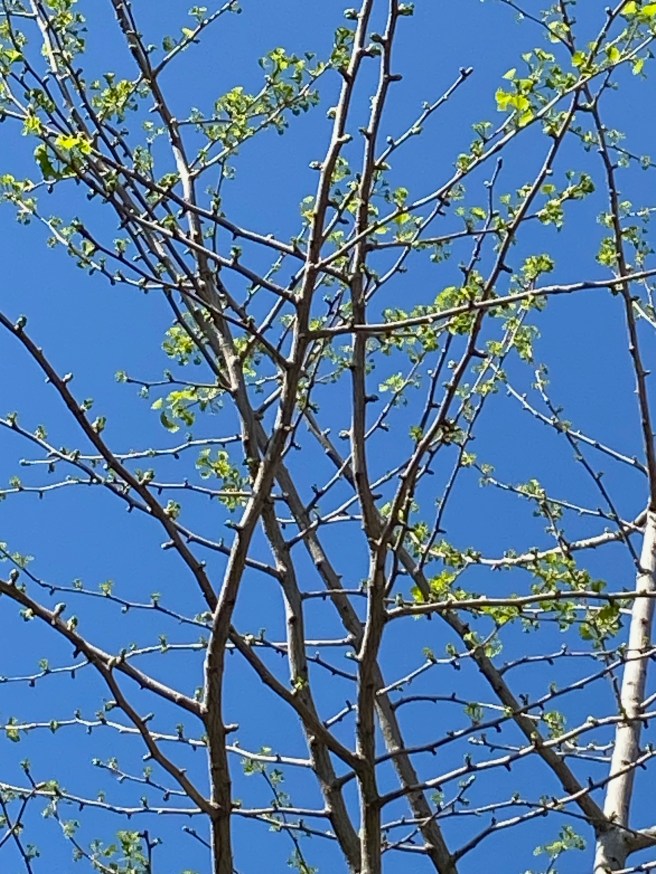
At the other end of the front fence is a ginkgo, probably about 25 years old. Already it has grown much higher than the top story of this block of units. In the best of circumstances this ginkgo could live for centuries more. I relish its great height, the fresh green of its summertime, the bright yellow carpet that it spreads in late autumn. Right now, in orange blossom time, I rejoice that the buds on the ginkgo’s branches are just beginning to open.
There is a narrow bed bright with perennials under the large front window of my home, and another wealth of colour between the two trees in the garden plot at the front. Flowering vines and shrubs loop through the fence. There is always colour; it changes season by season.
Less than a decade ago I was looking across a small suburban paddock adjacent to the Convent where our Sisters had lived and worked and prayed for close on 100 years. The task, shared by the school Principal and her staff, was to turn that patch into a Children’s Farm for the school across the street. The questions were: ‘Would under the huge lemon scented gum be the best place for the frog pond?’ ‘How many more trees bearing fruit in school time can we plant side by side with those already there?’ ‘What is the best place for the chickens?’ ‘Could there be a fire pit so that, in the evenings, classes of children might cook the produce from the farm and share a meal?’ There were years of work to bring this all together.
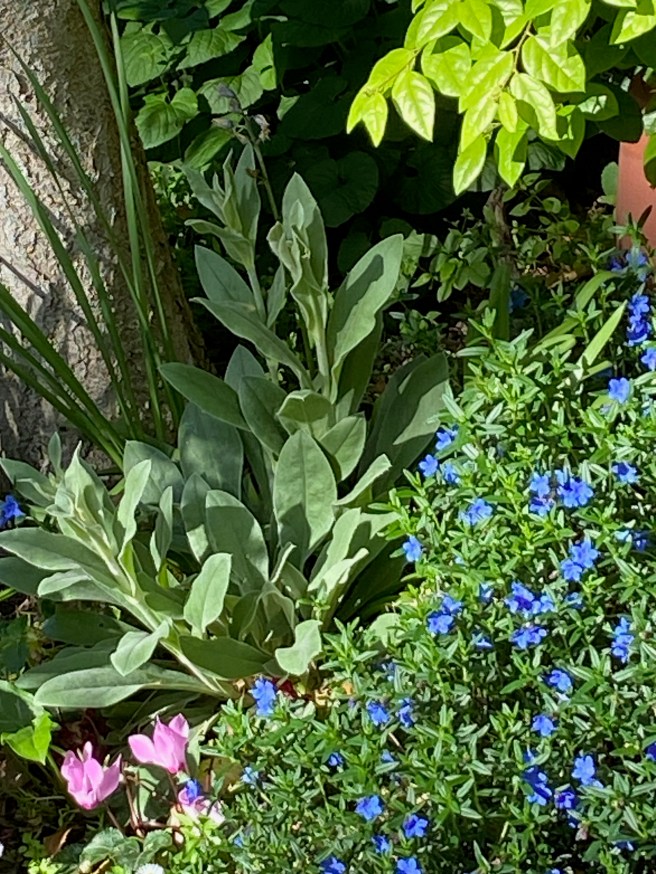
Here in Abbotsford it is a matter of thinking carefully about one tiny, shady space. ‘Which colours sit well together?’ ‘How can I ensure that there is never a time of no colour at all?’ ‘The dominant colour is green; can I carefully place many shades of green?’. Here the challenge is to select carefully: perennials and self-seeding annuals, a few no-nonsense bulbs and a cluster of pots of spinach, lettuce and herbs. I cannot offer any plant full sunlight, but I can move pots a little to catch the sun as seasons change. That’s it.
At certain times rays of sunlight filter into my garden through the branches of a European Elm at the kerb on the other side of our street. This tree has grown to an enormous height and width. Sometimes dappled shade lasts until midmorning. The sturdy young gum tree that Yarra Council has planted on the kerb on my side of the street will yield even more shade as it spreads its branches. Once again, shades of green.
For almost five years I have watched the sunrise through my front window which faces due east. I have learned to follow the pattern of sunshine. At the time of the winter solstice the rays of sunlight slant in from extreme north-east. As the months go by, I follow the movement of sunrise until, at mid-summer, the rising sun is straight in front of me. Due east.
Now, in the Spring, the pattern of sunlight is betwixt and between. Nestled close to the warm brick wall there is a blaze of vermilion coloured gerbera growing close to self-sown deep blue lobelia, and a yellow jasmine still holding a few winter blooms.
In full summer the colours will change. Pale blue plumbago will be there in profusion; my mother’s mother grew that in her small shady space. The hydrangea, lithodora and seaside daisies wait for their turn to show colour. Soon the correas will bloom pink and white. Blue, white, and pinkie-beige.

From Autumn, through winter and into spring there are impatiens, multi coloured, and bright flowering grevilleas. The begonia, red salvia and crucifix orchids, all thrive along the front fence; they never stop flowering.
Birds and native bees seek out this tiny garden.
Why do I write all of this?
At daybreak I stand in awe by my window to watch the dawn breaking. As the first of the sunlight touches this small garden, it shines. I write this to honour its beauty.
‘The world is charged with the grandeur of God
It will flame out like shining from shook foil..
It gathers to a greatness, like the ooze of oil,
Crushed …’
Gerard Manly Hopkins
 Stories and Musings