
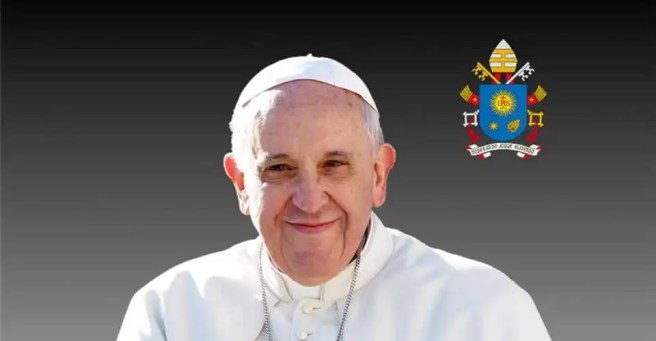
I watched the two-hour Vatican ceremony, the requiem for Pope Francis, with Mass celebrated in sunshine in St Peter’s Square in front of the Basilica. It was April 20th, 2025. Here a crowd of around 150 thousand people prayed together. There was silence, there was mourning, there was song and there was ritual to honour this man from Argentina who had guided the Catholic Church for twelve years.
Just six days earlier Pope Francis had given his Easter Sunday blessing from a balcony above this Square. He had looked down on the crowd below, pilgrims from across the world as well as friends who were anxious to see him after the weeks he had spent in hospital. After checking that it was a reasonable thing to do, he made an unscheduled decision to go down among the crowd waiting to greet him.
In the Square, with the white jeep making its way through the crush, Francis reached out to the people, especially the children, and the parents who lifted babies for a blessing. Did he know that this was his last chance to be among the pilgrims and the friends? Afterwards he said, ‘Thank you for bringing me back to the Square’. I know of no other last words.
I need to mourn this man Pope Francis, to remember the hope I felt in the changes he made. He, the first Jesuit Pope, claimed the name of Francis, the humble man of Assisi who gave away riches, who cared for people suffering in poverty, who cherished all creatures of the earth, all of creation. Brother Sun and Sister Moon.
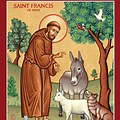
Jorge Bergoglio, the Cardinal from Argentina, who chose the name of Francis immediately made personal choices that flagged a change. He would live in the Vatican Guesthouse rather than the papal palace. He would dress simply rather than in grandeur. During his life as Bishop in Argentina, he had chosen public transport rather than limousines, his choice now was to continue to live among his people in every possible way.
This new pope came from a working-class family who had seen too much war in Europe and needed a safer place to rear a family. At that time there was a surge of European refugees seeking asylum in Latin America; the Bergoglio family chose Argentina, they had relatives there. Their child, Jorge, our Pope, grew up speaking Spanish as his first language. This eldest child of the family understood the horror of war, the risk-taking and humiliation of refugees. His family, of necessity, lived very simply among extended family and neighbours who helped each other to survive.
Here in Rome and in the Vatican, Francis chose to walk among the people, stay very close to them. Specifically he chose to reach out to those who were doing it tough; he wanted to be like a shepherd who knew the smell of the sheep.
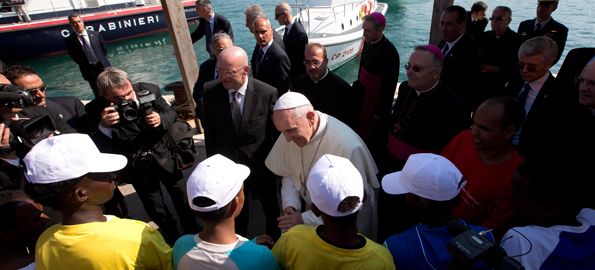
As Pope, Francis first journey outside Rome was to the Italian island of Lampedusa where women, children and men seeking asylum were detained, crowded in a packed ‘camp’. These people had undertaken a dangerous journey hoping to find safety in Europe; they had fled from persecution, war, hunger, and many perils in Africa. They knew that thousands had drowned while on fragile boats in these waters, but they had no other option. Francis heard them and spoke out for them; we who watched on TV were full of hope that this man would forge a different way of being Pope. As the years passed, he consistently chose to visit countries where life was dangerous and poverty rife.
Pope Francis collected friends and foes as he attempted to turn the Catholic Church, with 1.3 billion baptised members, into a “battlefield hospital” with its doors open to all, especially those on the margins. He was not supportive of an inward-looking church, set in its ways and clericalist. He wanted the church to be close to ordinary people and especially poor people, and all ‘misfits’ whom society spurned. The gospel was his guide; the way Jesus responded to outcasts was a gesture that demonstrated God’s tender care for all. Faith, hope, and love were intertwined. Francis habitually demonstrated gospel values through powerful gestures that didn’t need words.
On the Thursday before his death Francis went to a Roman jail. Normally on the Thursday of Holy Week he knelt and washed the feet of prisoners or refugees. This washing of feet mirrors what Jesus did on the night before he was crucified. It is a powerful gesture. On this, his last Good Friday, so close to his own death, Francis was too weak to wash and dry the feet but he talked with the six men and six women gathered to meet him and blessed a baby who was seated on her mother’s lap.
My own experience of childhood runs parallel in time with that of Francis. We each grew up in a country which was not the country of our distant ancestors. Our parents clung to their faith as world-wide depression, living ‘hand to mouth’, was followed by world-wide war. We heard of the suffering of front-line battles, the terror of families living in war zones, refugees fleeing danger and seeking safety. Perhaps his family, like mine, knelt in the kitchen to pray the rosary when atom bombs were dropped on civilians going about their daily life in Japan.
And so this Pope became engaged in multiple social issues: interfaith dialogue as a means of resolving conflicts; nuclear disarmament; an end to the death penalty; the rights of workers; refugees fleeing danger and seeking safety; the rights those living in war zones; the United Nations; Human Rights.
Pope Francis reached out to all who lived in extreme poverty or in war. He said, and I believe, that the brutal battles now raging in so many parts of the world should be called World War Three. He saw a world divided by fears and prejudices. He called world leaders and church leaders to work towards a better world for all of humankind. His vision was of justice, peace and love. People living in poverty, or in any way marginalized, had a God-given right to a fair share of the necessities of life: food, water, shelter, a livelihood. He spoke specifically about First Nations peoples whose way of life has been disrupted by colonisation.
Above all his concern was about the destruction of the Planet itself. It was his firm belief that humankind had responsibility as custodians of planet earth, this amazingly beautiful work of the Creator. In its complex web of life we are all connected as part of God’s handiwork. The Encyclical Laudato Si was a blueprint for this. The vocation of all people is to be faithful custodians of planet earth and its resources.
He had accomplished remarkable changes and seemed on the brink of achieving more in this year of hope. He had gathered a ‘Synod on Synodality’, a process aiming to involve ordinary laypeople more closely in decision-making in the Catholic Church.
It was in Laudato Si that he wrote. ‘Let us sing as we go. May our struggles and our concern for this planet never take away the joy of our hope.’
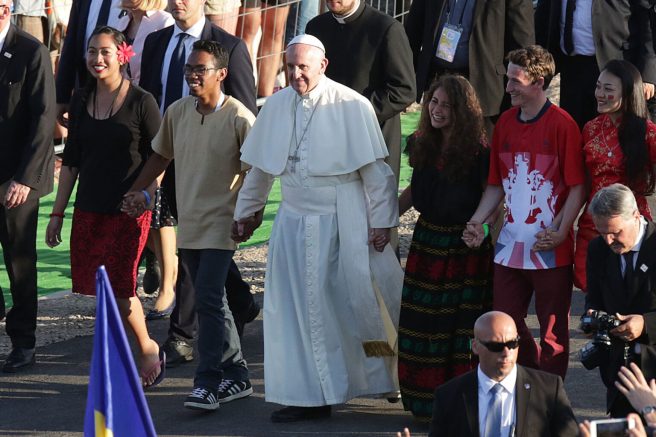
Finally Pope Francis named the year of 2025 as a yearlong pilgrimage of hope, of walking together. In a troubled and suffering world where all seems dark, he invited people throughout the world to hold to hope.
Pope Francis leaves behind unfinished reform of the Roman Curia, a blueprint for reform is in place.
Finally, On January 6th this year of 2025, he made a final gesture that signified hope. Pope Francis appointed Simona Brambilla the first woman to head a major role in the Vatican office. A Bishop will work under her guidance. We live in hope.
Pope Francis, Jorge Bergoglio, wrote an autobiography, already published. I quote from the first page.
‘All is born to blossom … hope is, above all, the virtue of movement and the engine of change … And if a dream fades, we need to go back and dream it again, in new forms, drawing with hope from the embers of memory.’
 Stories and Musings